Sleep Times: BodyMedia vs. Zeo
Most of those wrist-style activity monitors try to tell you how well you slept, but I’ve found the technology isn’t particularly accurate. Lately I’ve been trying the BodyMedia FIT armband, which also claims to tell sleep times. But how accurate is it?
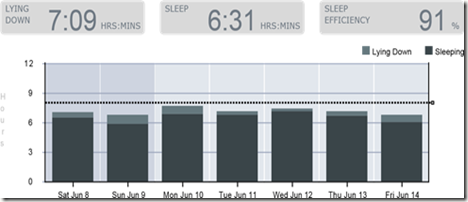
Here are my numbers after a week of wearing both devices.
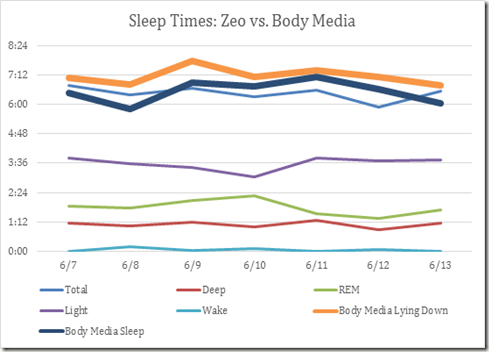
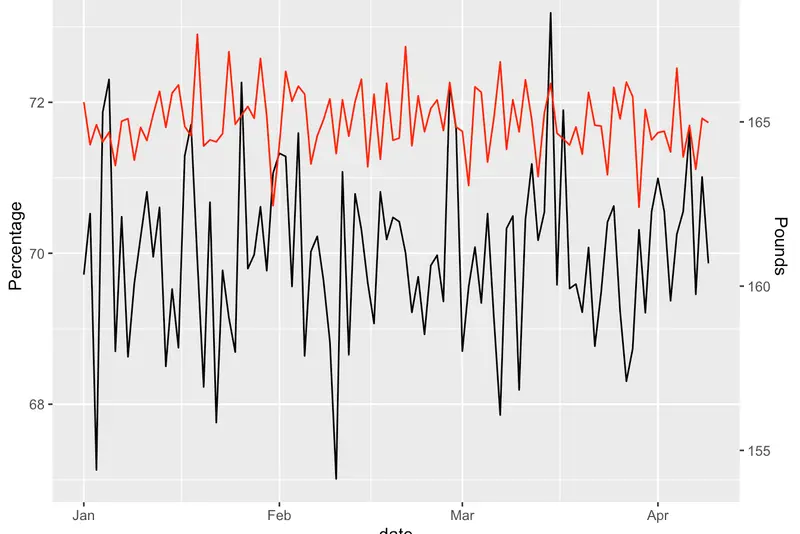
The bold lines are from BodyMedia and represent the time spent lying down (which should be pretty accurate) versus actually sleeping (which depends on BodyMedia’s algorithms for detecting when sleep starts, and may not be very accurate). The other, non-bold lines are from Zeo, the headband device from the (sadly) now-defunct Zeo Inc, which is clinically proven to be about 80% accurate.
The good news is that the two devices seem to roughly agree, at least on overall sleep times. For that, BodyMedia is pretty good.
BodyMedia also computes another measure they call sleep efficiency that is simply the ratio between the time it thinks you’re in sleep versus the total amount of time spent lying down. Unfortunately, I found no correlation between this and the more meaningful Zeo-calculated sleep phases: REM, deep, or light.
Our bodies are motionless during the REM sleep phase, as muscles are turned off, and we move again when the REM phase is finished. These regular movements throughout the night usually correspond with sleep transitions, which the armband accelerometer can in theory detect, but I couldn’t find that information in the BodyMedia. Other accelerometer-based devices use these movements to guess at when a REM phase began or ended, so conceivably BodyMedia could add that information in the future; or perhaps they’ve considered it but concluded it wasn’t accurate.
Bottom line: BodyMedia is okay as a measure of overall sleep times, but won’t tell you much more.