Inevitable Surprises
[my thoughts about the book Inevitable Surprises by Peter Schwartz]
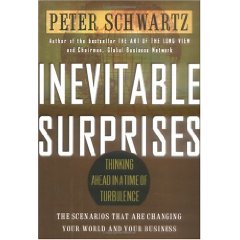
Predicting the future is not as hard as it looks. If extra rain in the mountains produces a flood upriver, you can be absolutely certain that eventually there will be problems downriver. Similarly, if you know something about today’s population demographics, you can be virtually certain what the demographics will be decades from now as those people age.
Peter Schwartz has built a career on making those sorts of certain observations about the future, and this book is a 2003 summary of predictions he sees as inevitable, however surprising or non-intuitive they may seem.
Peter Schwartz has built a career on making those sorts of certain observations about the future, and this book is a 2003 summary of predictions he sees as inevitable, however surprising or non-intuitive they may seem.
Here are a few of my takeaways:
- A stabilization and then decline in the world’s population will lead to:
- A rise in the retirement age: people will work productively into their 70s, 80s and 90s.
- Older people will divorce and start new social relationships after their children are grown.
- The increased crime, and accompanying incarceration rates of the 1960s and 70s will result in a huge release of prisoners starting in 2010, with unknown consequences for the U.S.
- China’s one-child policy results in a shortage of women that will cause wife-seeking emigration, ultimately resulting in a net influx of foreign women and families.
- Rising influence of a separate and unequal Muslim minority in Europe. This book presciently predicted the recent race riots in France, two years before they happened.
- United States foreign policy
- The U.S. is a “rogue superpower”, acting unilaterally for better and worse thanks to its unquestioned military superiority that will last at least another generation and beyond.
- U.S. rejection of international structures is dangerous and breeds mistrust.
- U.S. culture is about to be transformed from its traditional basis in the European Protestant idea of the ethic of “progress” into something new as Asian immigration brings along an ethic of “fate.” It’s unknown how these two cultures will synthesize.
- Spanish phrases will migrate into the mainstream. Chinese words will enter our lexicon too, but as much less common phrases.
- “Soft Power”, non-military influence through things like standards or trade, will be the only option left for other countries and they will learn to wield it for better and worse. The European Union rejection of the GE/Honeywell merger, or the Microsoft anti-trust case are examples.
- Energy: he predicts alternatives to fossil fuels will become important, notably a resurgence of interest in nuclear power.
- On the economy, watch out for the 20-40% group of people who are just above the poverty level and not taken care of by policy makers.
- Global climate change is inevitable but has unknown consequences.
- Plague and terrorism are also inevitable.
P. 168: “In the near future, speech recognition will become commonplace.”
I saw a few annoying mistakes that suggest the book was edited too hastily, ironic for a guy who likes to take the “long view”. For example, on page 157 he argues that 58M Chinese AIDS sufferers is a trivial 0.05% of the population, in contrast to Russia which may be as high as 10%. That’s bad math that calls into question his central argument.
He also predicts three key areas of technological advance: dark energy, the rise of information theory affecting physics, and space exploration. Notably missing is the whole biotech revolution, which I’m convinced, will be far more influential.
Although he describes the U.S. with the loaded term “rogue”, I think his analysis transcends politics. He correctly observes that U.S. policy toward, say, Iraq would not be much different no matter who the President is. U.S. policy reflects the attitudes of the electorate, on which a single leader has far less affect than most analysts assume.
Generally, I think the overall school of thought represented in this book is powerful stuff and needs wider attention.